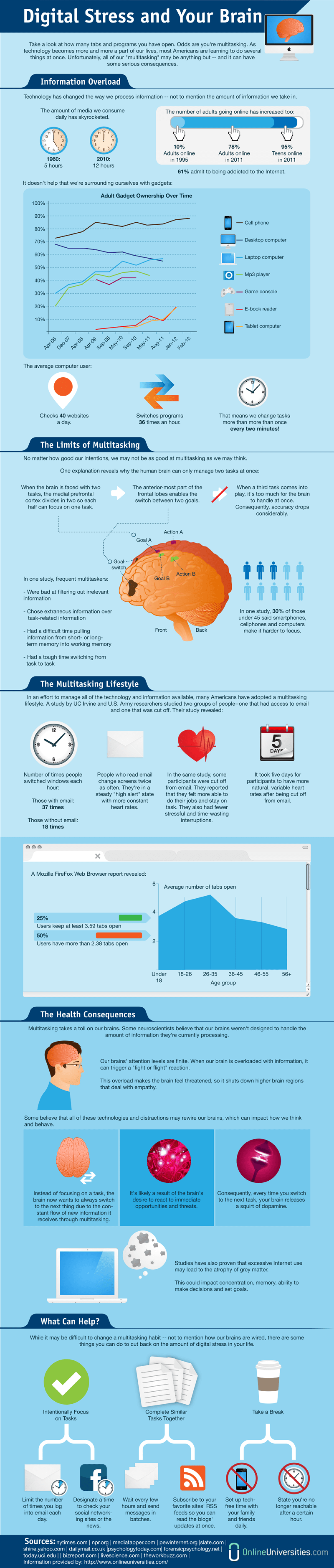
As technology usage increases, so does the amount of stress that we put on our brains.
It makes sense if you think about it because, although our brains have evolved over tens of thousands of years, the way that we use them on a day to day basis has changed dramatically in just the last fifty years.
The stress that technology puts on our brains is a sort of “digital stress” that is, in large part, due to an overload of multitasking when using computers, smartphones and tablets.
See Also: Effects of Video Games on the Brain [Infographic]
An infographic (posted below) was recently published by OnlineUniversities.com that provides us with information regarding how technology usage affects our brains, why it affects our brains and what we can do limit the negative effects it has.
Technology Related Stress in the Brain Infographic Highlights:
- The average computer user checks 40 websites a day.
- The average computer user switches programs 36 times per hour.
- The medial prefrontal cortex in our brains can easily manage 2 tasks at once, but when a third task is added, accuracy drops significantly.
-
In one study, frequent multitaskers:
- Were poor at filtering out irrelevant information.
- Chose extraneous information over task-related information.
- Had a difficult time pulling information from both short and long-term memory into working memory.
- Had a hard time switching from task to task.
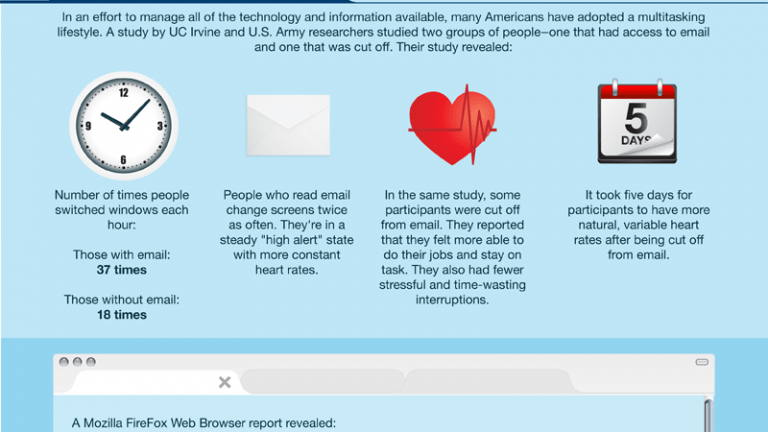
- A study by UC Irvine and the US Army showed that the brains of people with constant access to email remain in a “high alert” state.
- The same study also concluded that people with constant access to email had higher heartbeat rates than those who didn’t have access to email.
- A study by Mozilla Firefox revealed that 25% of Firefox users keep 3.59 or more internet tabs open at all times.
- Some neuroscientists believe that technology usage may overload our brains and cause certain areas to shutdown in order to compensate for the increased amount of information intake.
- Some neuroscientists also believe that our brain is beginning to evolve to accommodate our modern usage of the brain.
- Some studies report that excessive internet usage may lead to the atrophy of grey matter causing decreased memory, decreased concentration and impaired decision making abilities.
-
Three ways to help combat stress from technology usage:
- Focus on one task at a time.
- Complete similar tasks together (send all of your emails at once instead of 1 every 2 minutes).
- Take breaks!