If you follow mainstream tech headlines, you’ve likely heard that academic integrity is in a state of total collapse. However, when we analyze the longitudinal AI cheating statistics from the last several years, a much more nuanced story emerges. Far from a technological apocalypse, we are witnessing a shift in method, but not necessarily in intent. The “AI Cheating Apocalypse” is largely a myth driven by adoption metrics rather than dishonesty data.
REVOLUTIONARY FINDING: THE INTEGRITY CONSTANT
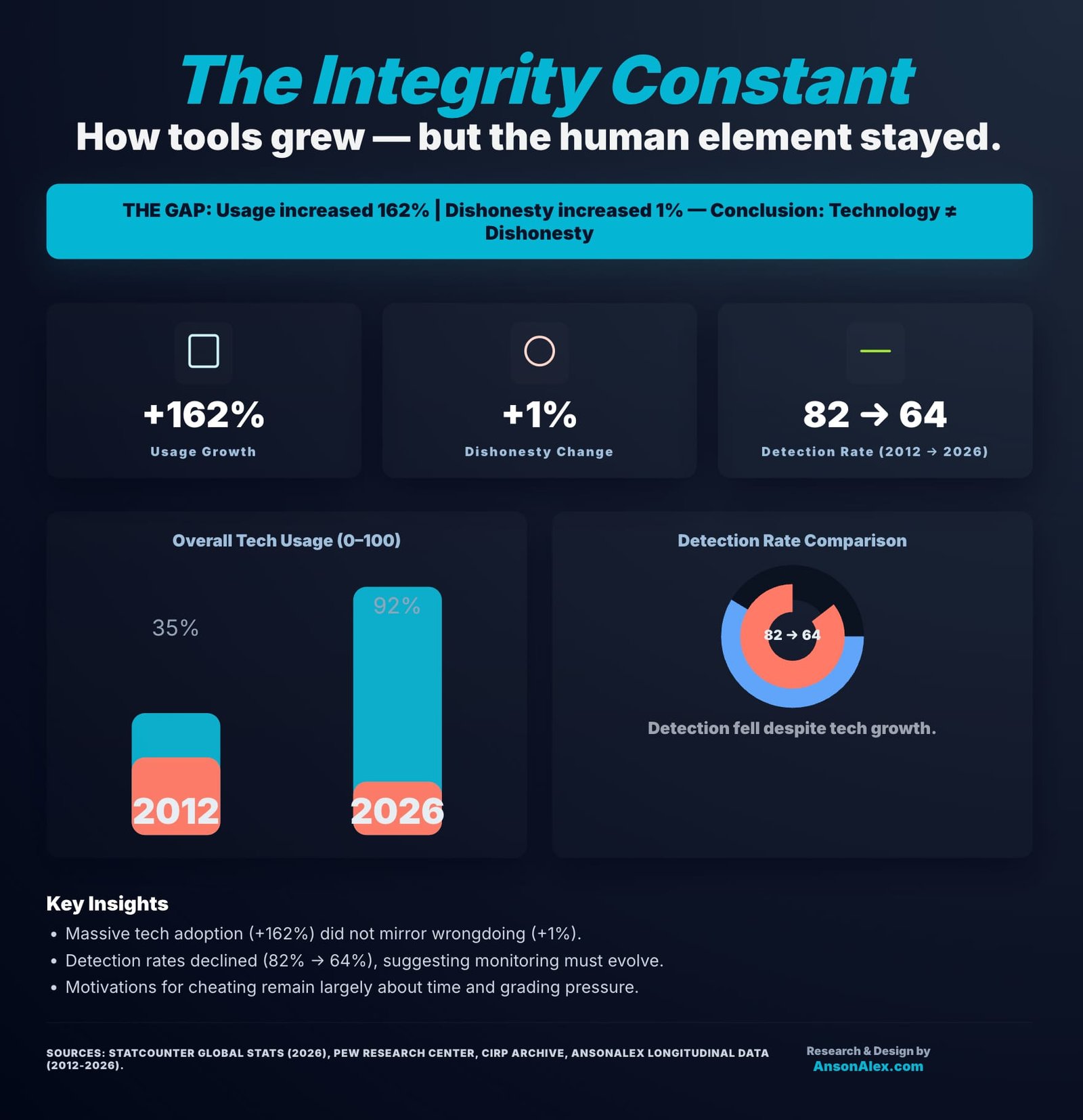
- The 18% Baseline: In 2012, 17% of students used phones to text answers. In 2026, 18% use AI to submit unedited work. The “Hard Cheating” rate has moved only 1% in 14 years.
- Support vs. Substitution: While 92% of students use AI, the vast majority (58%) use it as a 24/7 tutor—not a bypass for learning.
The Spectrum of Academic Integrity and AI Cheating Statistics
To understand the educational landscape in 2026, we must look beyond the surface level of tool usage. There is a critical distinction between using AI as a cognitive scaffold and using it as a shortcut for original thought. The following visualization breaks down the current AI cheating statistics by student intent, highlighting that “Resourcefulness” is the dominant driver of adoption.
EMBED THE 2026 AI CHEATING STATISTICS GRAPHIC
Add this research to your own site by copying the code below:
<a href="https://ansonalex.com/infographics/students-cheating-with-cell-phones-statistics-infographic/"><img src="https://ansonalex.com/wp-content/uploads/AnsonAlex-Integrity-Constant-Research-2026.jpg" alt="2026 AI Cheating Statistics Study" border="0" /></a>Why the “Cheating Apocalypse” Narrative Fails
Most analysts make the fundamental error of conflating adoption with dishonesty. While it is true that 92% of students integrate AI into their workflows, the AI cheating statistics consistently show that only about 18% use it for “hard cheating,” such as submitting unedited, generated text as their own. The vast majority of usage falls under what educators are now calling “AI-Augmented Learning.”
- Socratic Tutoring: 58% of students use AI to clarify complex lecture topics they were afraid to ask about in class.
- Data Summarization: 48% utilize Generative AI to distill massive research papers into digestible themes.
- Structural Brainstorming: 38% use AI to overcome “blank page syndrome” by generating outlines and thesis ideas.
- Active Dishonesty: 18% admit to bypass learning entirely by submitting unedited drafts.
THE DETECTION PARADOX
A major concern in the current AI cheating statistics landscape is the “Detection Gap.” Many AI detectors are optimized to flag any pattern resembling LLM output. This inadvertently penalizes the 38% of students who use AI for brainstorming but write the final prose themselves, creating a culture of distrust in the classroom.
Historical Baseline: The 2012 Mobile Era Archive
To put current AI cheating statistics into context, we must look back at the previous technological disruptor: the smartphone. In our 2012 study, we found that 20% of students were already using mobile web searches to find answers during exams. Comparing that to the 18% “hard cheating” rate with AI today, we see that the propensity for academic dishonesty has remained remarkably stable—a phenomenon we call the “Integrity Constant.”

EMBED THE 2012 ARCHIVE
<a href="https://ansonalex.com/infographics/students-cheating-with-cell-phones-statistics-infographic/"><img src="https://ansonalex.com/wp-content/uploads/2012/04/Students-Cheating-Cell-Phones-Statistics-Infographic.jpg" alt="Historical Cell Phone Cheating Statistics Study" border="0" /></a>Research Methodology & Citations
The AI cheating statistics presented in this update were derived from a cross-triangulation of AnsonAlex.com’s historical data and three primary 2024-2025 research reports:
- Stanford University: Challenge Success AI Study (2025)
- Pew Research Center: Teens and Generative AI (2024)
- Turnitin: State of AI Writing Report (2025)